
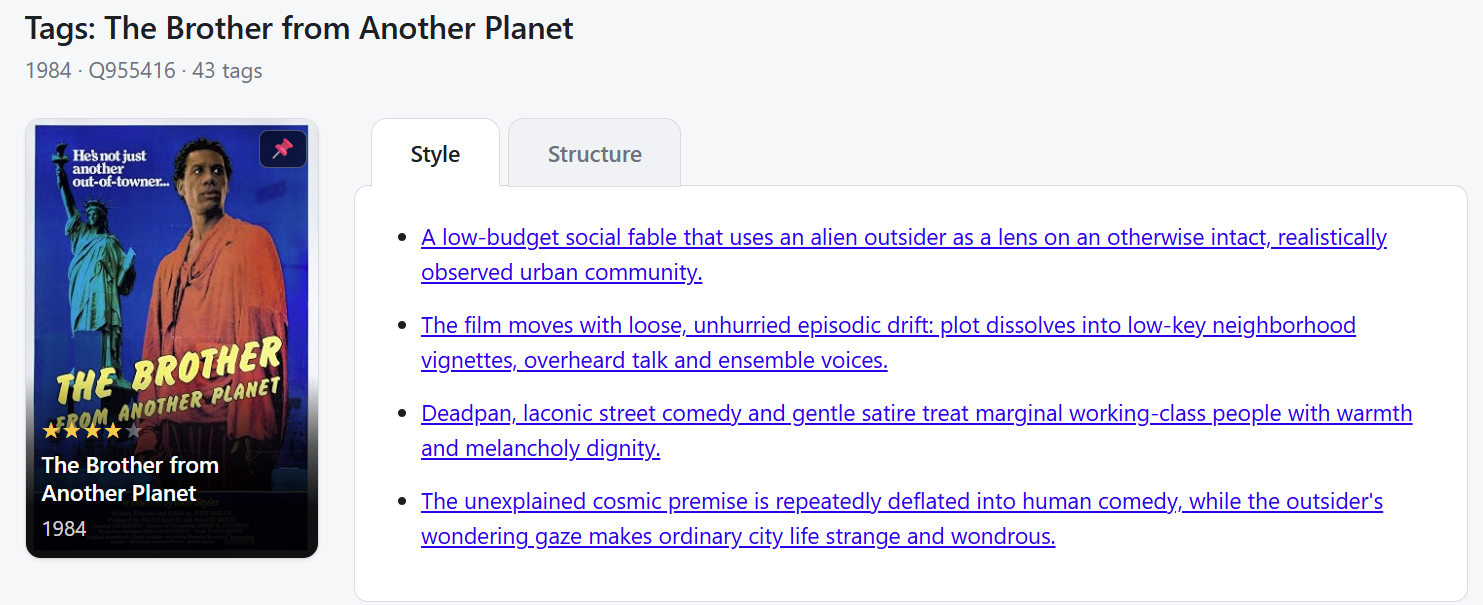
I’ve been working on a new feature of my film recommendation website. I’m creating short descriptive sentences that are bigger than a tag and smaller than a description. They are also crafted is a specific way I’ll talk about in a minute. Here’s The Brother from Another Planet on the style tab (you don’t have to read this image, I transcribe it below):
And here’s for structure:
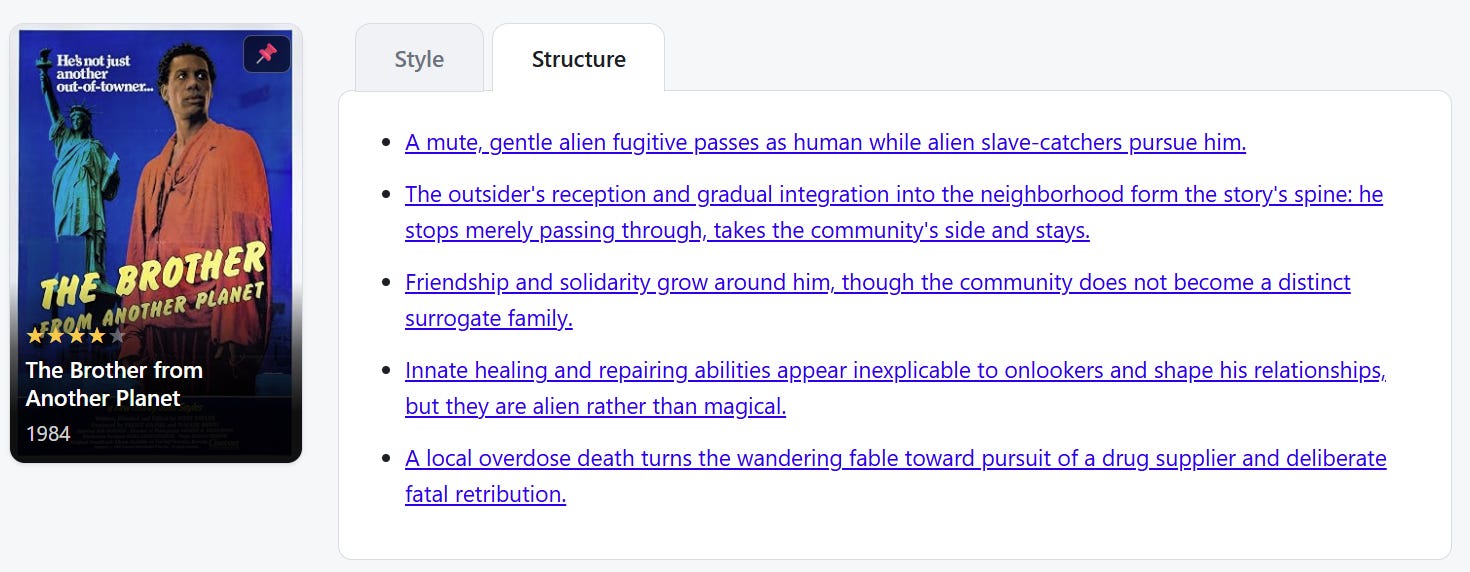
Now some of these are pretty specific, and some are pretty broad. These particular summary phrases consolidate answers to questions I’ve asked about this film (along with 23,000 others) over four or five months. I’ll explain more in a second post, but to be clear I didn’t simply ask the AI to emit four cool facts or something like that, they are actually formed by a network of hundreds of applied tags.1
In this case, each one is a link, and I’m going to encourage you to click one below:
You’ll get something slightly different every time you click those linked descriptions but here’s what I get when I click the top one. It feeds the description to Google Search and asks for five films that that description might describe.
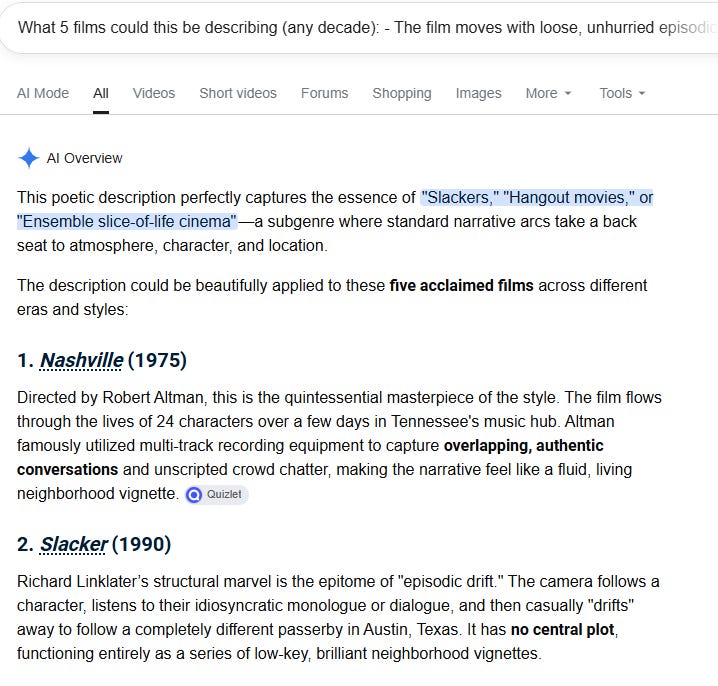
(If the link doesn’t generate an AI response for you, follow clicking the link by clicking the “AI Mode” button on the top left of the Google page. In fact, for better results ans less error I always recommend clicking the AI Mode link.)

Now when I saw Slacker there (in the likeness matches for The Brother from Another Planet), I felt… joy.
I don’t know if I can describe why if you haven’t seen these films, but I’ll try. Brother from Another Planet is a very different film. Slacker is famously plot-less, with a camera that wanders through conversations and slice-of-life vignettes in Austin, never staying put long enough to let the story evolve. Brother from Another Planet is not known for a tight plot (to say the least), but it does have one, and is designed as explicit social allegory. In it, a mute alien slave escapes to Earth. Because he looks like a Black man, he blends into the community in Harlem, or to be more precise, kind of blends in, encountering a variety of characters as he explores this world. The plot drifts but does develop. It builds to a socially meaningful climax and resolution where the alien acts to protect his newfound community.
The thing is I would have never thought to put these two films side by side. But once you see it, you can’t unsee it. It’s been a while since I watched Brother, but I remember the experience of the first part of that film. The alien (never named) drifts through various slice-of-life scenes in Harlem, and the felt effect is similar. The alien, mute and a stranger, is in effect the roving camera of Slacker, taking in this strange world. This is of course just a match on a single dimension, but it is there and real.
Here’s a clip from Brother, which is fairly indicative. The muteness of the main character means he walks into a lot of scenes and characters just monologue. In this case the young woman in the scene is sort of talking about the video game she is playing but she is also explicitly talking about her life, where the world goes slow and she goes fast, and the result is that she lives a constant stream of events that she sees long before they are coming; she sees problems a long way away, but there is nothing to do but to wait for them to arrive and shoot them down.
And look, I know this is a weird connection, but here’s a bit of that roving camera in Slacker, this time with a woman expounding on her desire (however trite in her exposition) to get past traditional frames and lenses on society, beyond the traditional categories of experience.
These aren’t a perfect match, but happened to be two available clips. But they capture how these films connect on the axis of the description.
Each is powered by a wandering camera through these two different subcultures, meeting the variety of characters that populate them in this loose way, with those characters often monologuing at length in ways that capture a place and a moment and a human longing as imperfect as it may be expressed. In one case 1980s Harlem, and in another 1990s Austin.
Out of curiousity, I looked to see if others had noted this connection. If someone has they do not seem to have put their thoughts on a page indexed by Google, at least at a short scan. Which is not that strange; in general these are films with different overall feels and different aims. I get it. But even if it is an imperfect link it provided me something to think about, and more importantly, to think with.2
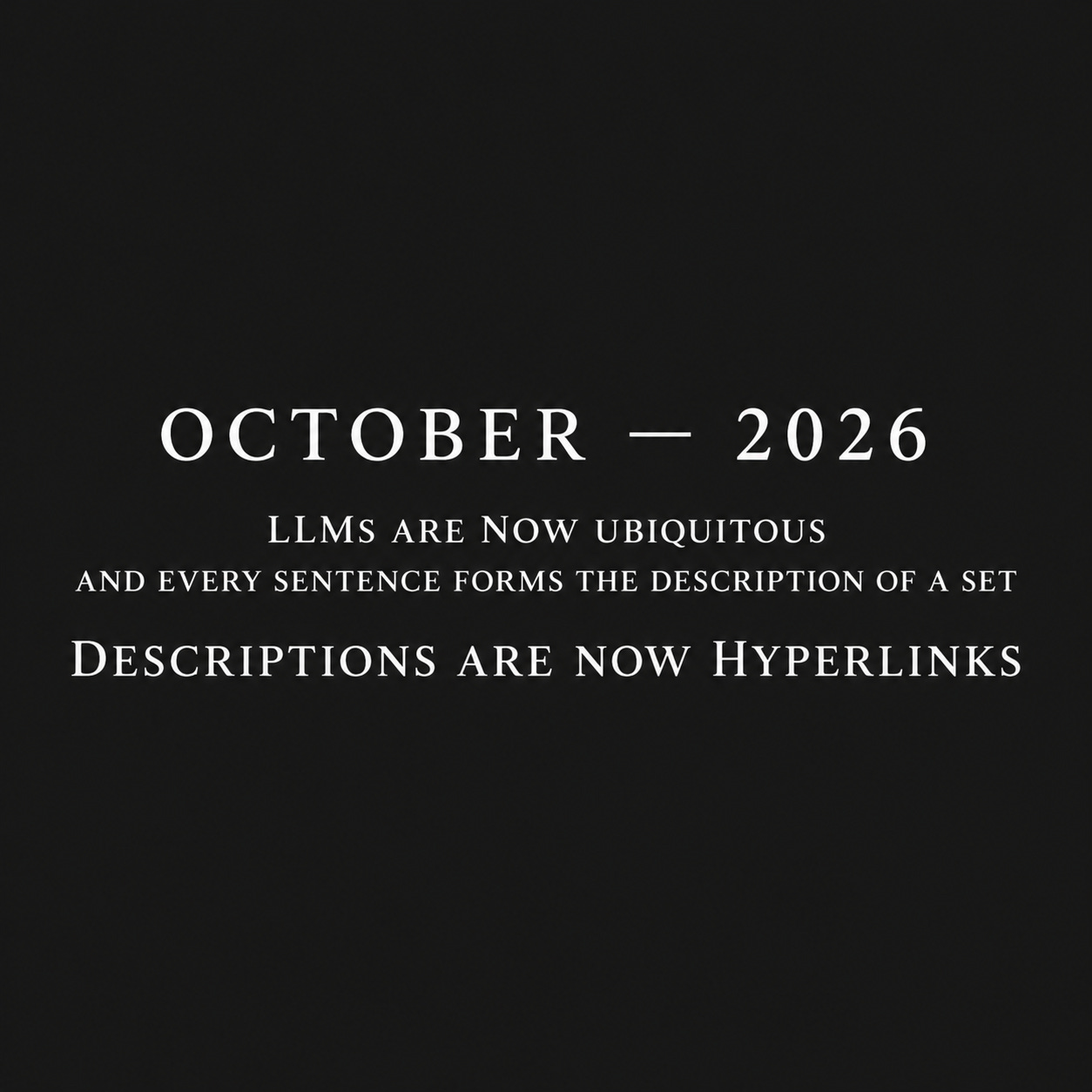
October 2026: Descriptions are now Hyperlinks
Ages ago Vannevar Bush dreamed of the Memex, a device that would allow researchers, scholars, and others to draw connections between different details of work. His famous example was of a person reading someone else’s history of Turkish short bow and linking it to information on the physics of it, a cross-disciplinary lateral connection. The insight was that ideas, research, and material could become connected in a broad web of information, sometimes in surprising ways. Through a tree of different adopters and thinkers this idea eventually showed up in tech products like Apple’s Hypercard and ultimately the web.3
Doing the little exercise above I can’t help but think that descriptions have become hyperlinks. A description that is well designed to the right degree of specificity and abstraction becomes a pointer to a set of related films, ideas, options, diagnoses, possible solutions. To describe and decompose a thing into composable elements is to be able to surface previously unseen connections, the way we dreamed the memex might.
And that’s the pitch.
I’m making this short for two reasons. First, if you want more, I do a walkthrough of the idea in the video below:
But more importantly the best way to understand the idea is actively. Go to the site, and put a film you know and like in the search bar and hit enter (I don’t have this year’s films yet, sorry, but have a good selection through mid 2025). Then search it, and click either the style or structure tag.
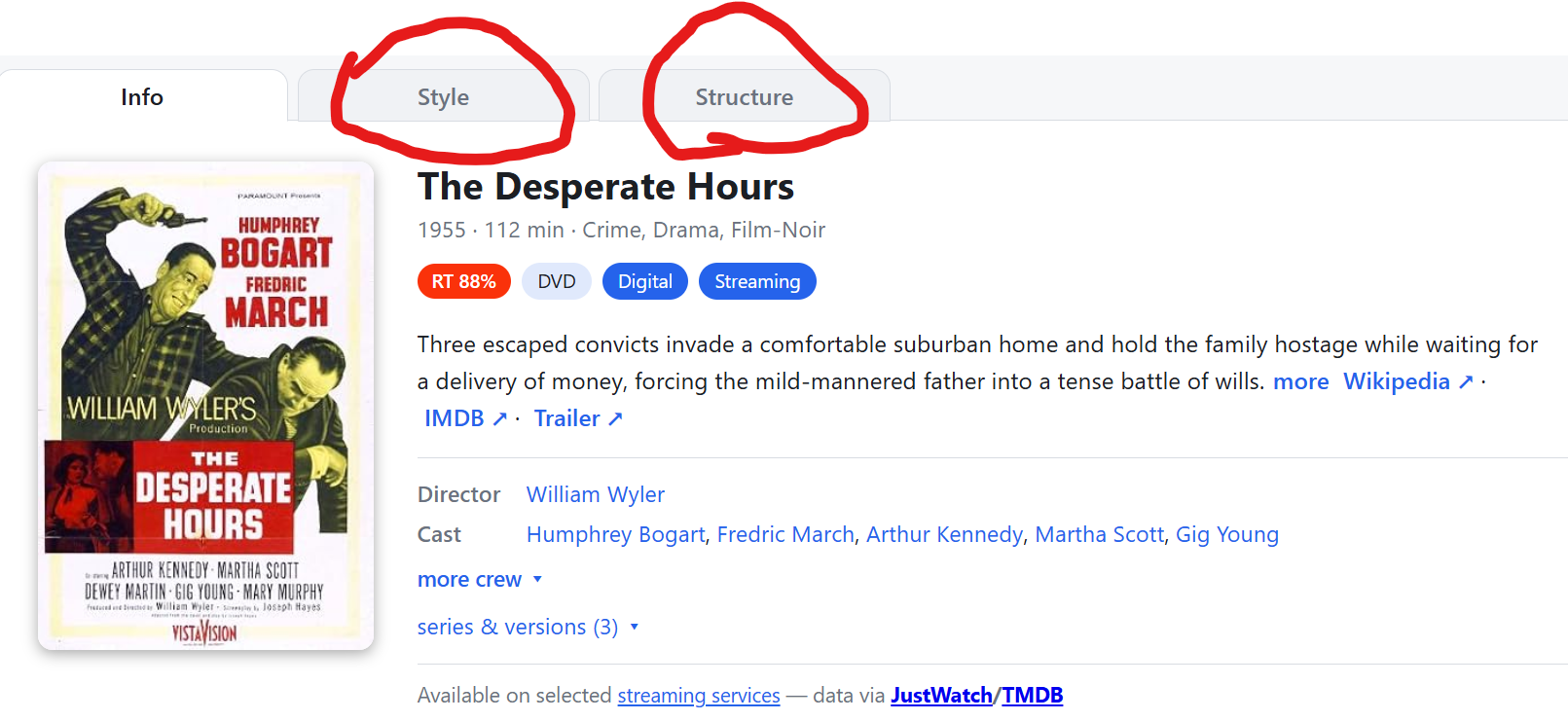
Then click either the links (common matches) or the telescope (limit to less known).
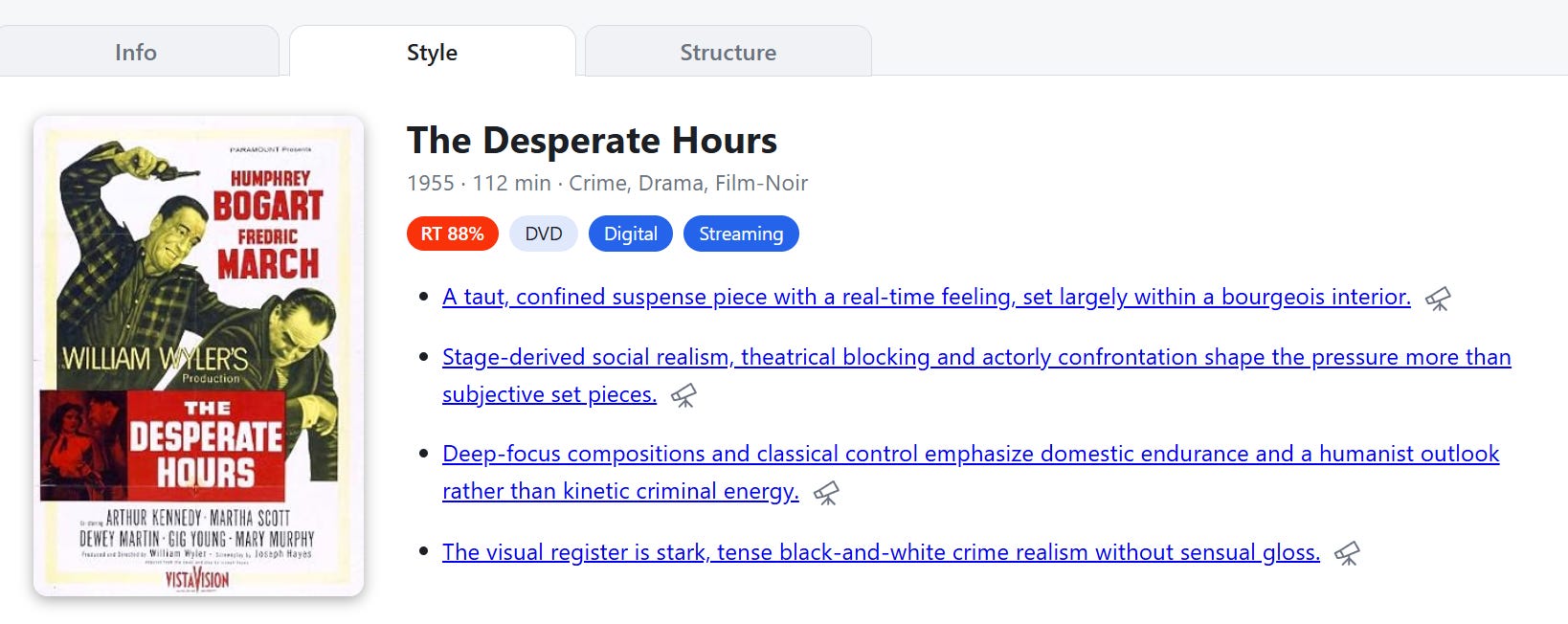
Flip through the results
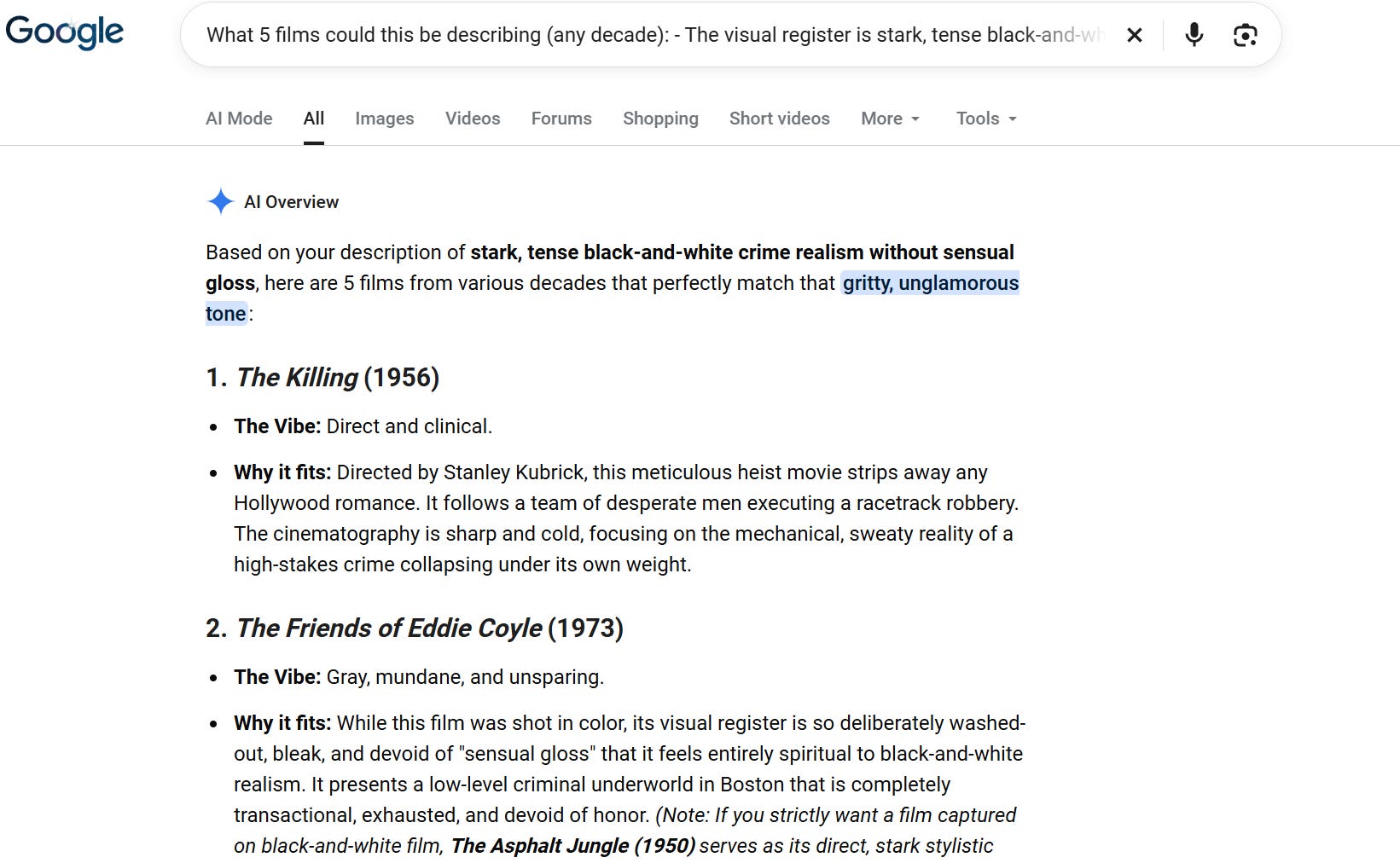
Change it if you want, make it a film from the 2010s

Whatever makes sense for you. But play with it is an area you have a tiny bit of knowledge. Or one that you don’t where you’re willing to do the “hard” work of watching a movie outside the normal homogenized recommendations.
Descriptions are now hyperlinks. I think this will be obvious if you give it a shot. To describe is to form previously unseen connections, ones that can expand your horizons and also, hopefully, find you something interesting to watch.
Maybe this matters, and maybe it doesn’t. All I know is on the films I know they are unsually good decompositions of its composable elements, and don’t veer into error.
This is usually the place where someone interjects in the comments “Aha! But you had to know something to know that the link was good,” hence LLMs are worthless, or can’t produce new knowledge etc. If you are the person who are saying this while reading this post, I’d advise you thinking through how people acquire knowledge without LLMs, and the levels of understanding that are required to integrate new knowledge from any source. Epistemology is in fact a total mind blower, but it is not confined to using an LLM. I don’t mean to be abrasive with this footnote but it always bums me out when I write a post like this based on deep experimentation over the course of a week and someone comes in with their 2024 cliche tool belt, and I am just trying to avoid comments that bum me out.
Of course, there was one problem with the web version of that idea, one reason why the vision was dead on arrrival: on the web, only authors (not readers) could hyperlink text and therefore you were limited o discovering the connections the author of what you were reading knew about, which wasn’t that much different than before. As I have argued elsewhere, it was not the hyperlink on its own that made the web “webby”, it was web searches use of the hyperlink, both as an input into the process and an output. But even then it was incomplete.
So I went to try your website and it is quite impressive.
"descriptions have become hyperlinks. A description that is well designed to the right degree of specificity and abstraction becomes a pointer to a set of related films, ideas, options, diagnoses, possible solutions. To describe and decompose a thing into composable elements is to be able to surface previously unseen connections, the way we dreamed the memex might."
I agree. So is the point you making "AI" even Google AI overview at the stage it is good enough to do this on it's own even (without webpages pointing out connections)?
Tip: You don't have to pay through the nose to get an LLM to produce movie descriptions. You can get a lot for free at TMDB:
https://www.google.com/search?q=can+i+get+plot%2C+keywords%2C+recommendations+for+free+at+tmdb