
I watched the film Past Lives recently which is frankly a stunning piece of work. You shouldn’t be reading this post, you should be watching Past Lives.
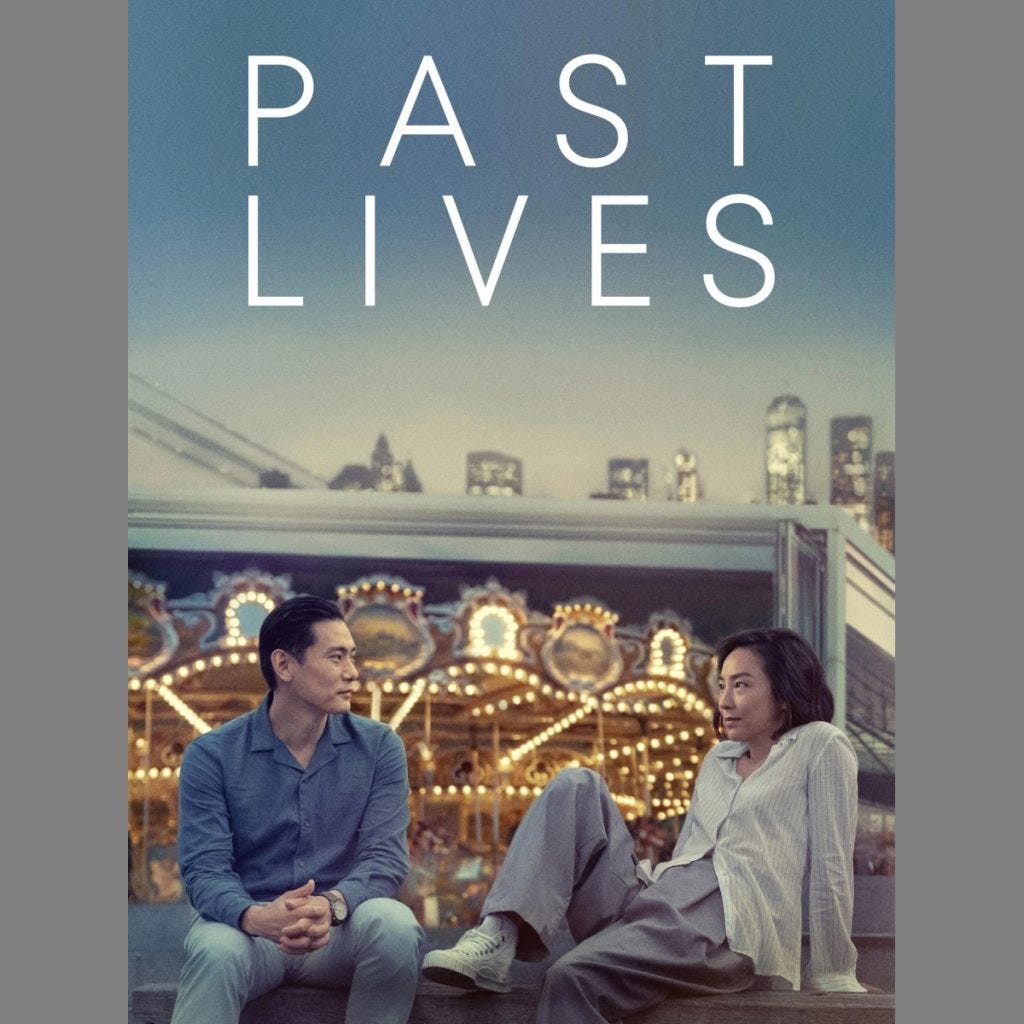
Past Lives makes a reference to Eternal Sunshine of the Spotless Mind in it, and after hearing that I couldn’t help thinking of Past Lives as a sort of Eternal Sunshine without the scifi bits. They are such very different films. But something about the way the story was told, how fate and different realities map on top of characters with a sweet melancholic fragility seemed to connect them.
I’ve been working on my film style tags, and set myself to writing out what I think ties them together; I then wrote it out to capture something my current prompts were missing:
Name films like this: **A relationship as a constellation of privileged moments** | The character’s relationship is told as a series of both small and larger emotionally dramatic moments that together create the feeling of a relationship that in this world was fated to follow this arc, but is not defined simply by its ending. A silent perfect moment can weigh against the greatest heartbreak or disappointment, it is all true at once. The idea of parallel universes, time loops, “sliding door” choices, and fate weigh heavy.
You can see the list here.
Closest matches (the structure and the fate/parallel-universe weight are both there):
Arrival (2016) – the purest version of “it is all true at once.” The daughter’s whole life is shown as moments that are simultaneously past, future, and chosen.
Eternal Sunshine of the Spotless Mind (2004) – the relationship is literally a set of moments being erased in reverse, and the ending suggests it’s fated to happen again anyway.
Past Lives (2023) – in-yun as the organizing idea; three meetings across decades, the road not taken sitting inside the road taken.
La La Land (2016) – the epilogue’s alternate-universe montage weighs the actual outcome against the might-have-been without cancelling either.
Comet (2014) – explicitly set across parallel universes; a relationship told out of order in five or six scenes.
Mr. Nobody (2009) – every branch of a life with the same woman played out; the film refuses to pick which one is real.
Je t’aime, je t’aime (1968, Resnais) – a man in a time machine reliving random minutes of a dead relationship. Probably the ur-text for this trope.
Two for the Road (1967) – a marriage shown as five road trips intercut nonlinearly; the same stretch of highway in different years.
Strong on the “constellation of moments” structure, lighter on multiverse/fate:
(500) Days of Summer (2009) – shuffled days, expectations vs. reality split screen, the ending hints at fate with “Autumn.”
Blue Valentine (2010) – beginning and end intercut so each weighs on the other.
One Day (2011 film; the 2024 series is better) – the same date each year, fate implied by the structure.
Annie Hall (1977) – the memory montage at the end is the thesis: it ended, and it was still worth it.
Aftersun (2022) – parent and child rather than lovers, but built entirely from privileged moments viewed from after.
The Before trilogy (1995–2013) – three long moments, each carrying the ghost of the missed ones.
Weekend (2011) and Lost in Translation (2003) – a single short window that the films treat as complete rather than cut short.
Up (2009) – the Carl and Ellie montage is the whole trope in four minutes.
Strong on time loops / sliding doors, relationship is the vehicle:
About Time (2013), The Time Traveler’s Wife (2009), Sliding Doors (1998), Palm Springs (2020), Groundhog Day (1993), The Map of Tiny Perfect Things (2021), Your Name (2016), The Girl Who Leapt Through Time (2006).
Adjacent, worth a look: Everything Everywhere All at Once (2022, mother-daughter across universes), The Fountain (2006), Slaughterhouse-Five (1972), Hiroshima mon amour (1959), Certified Copy (2010), Cloud Atlas (2012), and on TV, Undone, Russian Doll, and Normal People.
If you want one line for the taxonomy entry’s “see also,” I’d point at Arrival, Eternal Sunshine, Past Lives, and Je t’aime, je t’aime as the anchors.
That’s a good set!
Does the prompt need to be written like that to get that set? Probably not. (Conversely, had I known I’d be using this as a public example I probably would have fixed a couple of the repeated words).
But my point is this.
We spend so much time talking about how writing is thinking, and I believe that is true. But if writing is thinking, so is prompting, right? Sitting down, and trying to pick every word in that paragraph in a way that both binds two films and their vibe together while staying broad enough to let the unexpected come in.
Name films like this: **A relationship as a constellation of privileged moments** | The character’s relationship is told as a series of both small and larger emotionally dramatic moments that together create the feeling of a relationship that in this world was fated to follow this arc, but is not defined simply by its ending. A silent perfect moment can weigh against the greatest heartbreak or disappointment, it is all true at once. The idea of parallel universes, time loops, “sliding door” choices, and fate weigh heavy.
Is that not writing? Not thinking? Is the fact it goes toward a prompt make it not count? (And if so is my feeling that I understand these movies more deeply after writing the prompt illusory?)
Or are we being far too small-minded about what counts?
Was the sense of understanding from the prompt or the reply, when the list resonated with your intent? It doesn't have to be one or the other, I'm just curious. My husband cooks, and is happiest when the meal tastes like what he imagined, even when the unintended meal is delicious. The degree of satisfaction is in his head, not the diners'. I feel like that about "perfect sentences", and can have the feeling as a writer or a reader.
Fwiw, yes, writing prompts is writing, but perhaps always transactional writing?